Lucy Allsop
Never Kiss a Man in a Christmas JumperLucy Allsop is a bride whose wedding becomes less an uncomplicated celebration than a test of how to hold on to what matters amid mounting expectations. At her fittings, anxiety gathers around the dress and the event together; on her wedding day, she appears almost overwhelmed by the very occasion meant to celebrate her. Maggie O’Donnell’s practical reassurance and Marco Cavelli’s compliment briefly redirect Lucy’s attention from the pressure surrounding the day to her marriage to Josh.
Identity and Bridal Preparation
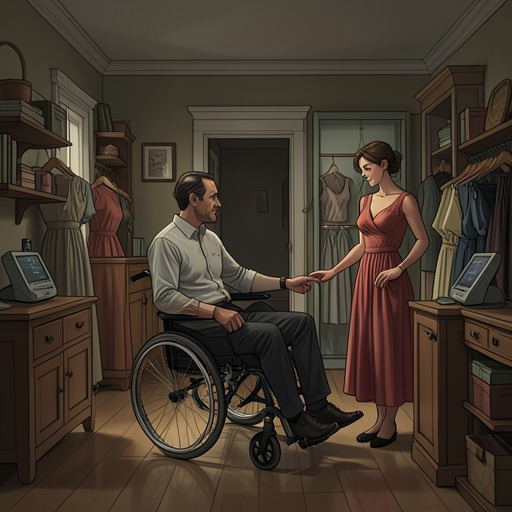
Lucy first appears at Maggie O’Donnell’s bridal shop emerging from the fitting room in a gown Maggie has made with considerable care. Tall and slender, with deep brown hair and sun-kissed skin, she wears a fitted A-line dress that skims her waist. Its V-neck suggests shape while retaining a restrained, elegant cut; lace appliqué covers the gown, and sheer lace sleeves and a sheer back give it a vintage character. The pure-white fabric suits Lucy’s coloring, and the dress’s precision makes it seem made expressly for her—because it was.
Her uncertainty is immediately visible in the contrast between the gown’s assured workmanship and her nervous response to it. Lucy runs her hands over the lace and asks whether the dress is too tight. Maggie recognizes this as a familiar kind of bridal worry: in her experience, such questions often express fear about the life-changing event ahead rather than a genuine problem with the dress. Lucy’s concern has a particular context. A wedding that began as a family gathering has expanded into a large, sprawling occasion, and pressure from her parents and in-laws has left her feeling that she has lost control. Recent fittings have brought tears, and one included emergency Prosecco. The dress is therefore both an object of care and the focus onto which broader wedding stress can settle.
Reassurance in the Shop
Lucy’s appearance in the gown takes place before Maggie’s unexpected visitors, Rob and Leah. Leah, heavily pregnant, breaks the awkwardness by telling Lucy she looks gorgeous. Rob, whose striking appearance catches Lucy’s attention, also responds to the dress: Lucy blushes at his words and nods before returning to the fitting room to try on jewellery. Maggie tells Lucy she looks fantastic and that both bride and dress are breathtaking, then offers to come back in a few minutes to help her out of it. Lucy gives Maggie a small, sad smile before glancing once more toward Rob. She seems reassured enough to withdraw to the fitting room, though the moment does not erase the strain surrounding her preparations.
Maggie’s help extends beyond making and fitting the gown. She understands that Lucy’s questions about its fit may be a way of expressing apprehension about the wedding itself, and responds as both dressmaker and confidante. That distinction matters in Lucy’s story: the garment can be finished to a high standard, but its perfection cannot by itself resolve the pressures that have accumulated around the celebration. The shop offers a quieter setting in which Lucy can receive affirmation without having to manage the whole wedding at once.
The Wedding Day
Lucy’s wedding differs sharply from the more openly festive occasion Maggie has attended for Gaynor. Lucy’s dress is tasteful, her makeup understated, and her hair beautifully arranged; the restraint of her appearance communicates class. Yet Maggie also sees tension in it. Lucy has gone through the service like a sleepwalker and now receives her guests as if hosting a funeral rather than enjoying what is supposed to be the happiest day of her life. The contrast between polished presentation and visible distress echoes the earlier fitting: the gown and styling are composed, while Lucy herself remains under pressure.
When Maggie and Marco reach the head of the receiving line, Lucy looks close to buckling under the stress. Seeing Maggie brings a warm smile to her strained face. She reaches for Maggie’s hands and glances in confusion at Maggie’s companion, whose appearance seems familiar to her and yet changed. Maggie responds not by praising the wedding arrangements but by offering concrete advice: Lucy can take off her shoes, have a drink, and remember that she and Josh are there because they love each other and have chosen a lifelong commitment. Guests, in-laws, and even the dress, Maggie tells her, are secondary to that choice. The marriage is the beginning, not the end, and holding on to that thought may help Lucy get through the rest of the reception and perhaps begin to enjoy it.
Lucy nods as Maggie speaks, and some of the tension appears to leave her. Maggie squeezes her hand before moving on. Marco lingers to tell Lucy that she looks absolutely stunning. As he walks away, Maggie knows Lucy is blushing prettily while watching him. The two brief interventions address different parts of Lucy’s unease: Maggie recalls her to the meaning of marrying Josh, while Marco offers a direct compliment that lets Lucy receive admiration without having to defend the dress or manage the celebration. The scene does not claim that the strain disappears, but it shows Lucy responding to kindness in the middle of it.
Change and Narrative Significance
By the wedding reception Lucy is identified as Lucy Morgan, marking her new married name, but the account does not turn her into a fully resolved portrait after the ceremony. Her arc is narrower and more situational: at a fitting, she fears that the dress may be wrong while the larger event has escaped her control; on the wedding day, she carries that pressure through the service and into the receiving line; then reassurance helps some of it ease. The movement is not from anxiety to effortless happiness, but from being nearly consumed by wedding expectations to being reminded of the commitment at their center.
Lucy’s scenes also distinguish the visible trappings of a wedding from its underlying purpose. Her gown is genuinely beautiful, and Maggie’s craft matters, but neither the garment nor a perfectly managed event can guarantee that the bride feels at ease. Maggie’s advice reframes the day around Lucy and Josh’s love and decision to share their lives. Lucy’s response—a nod and a release of some tension—gives that idea a modest, concrete consequence. As a supporting character, she brings into view a pressure familiar to the novel’s wedding-centered episodes: public ceremony can become so large that its participants lose sight of the relationship it is meant to honor.